
On January 1, 2026, the USA Minimum Wage Increase 2026 came into force across a wide range of U.S. states and local jurisdictions, raising hourly wage floors for millions of workers. The changes were implemented automatically under laws passed years earlier, including statutes adopted by state legislatures and voter-approved ballot initiatives.
The increases primarily affect workers in retail, food service, hospitality, caregiving, and warehouse operations. In many states, the new rates represent incremental steps in multi-year plans designed to raise wages gradually while giving employers time to adapt.
Table of Contents
Federal Minimum Wage Remains Unchanged
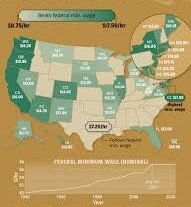
Despite widespread state-level action, the federal minimum wage remains $7.25 per hour, unchanged since 2009. Under U.S. labor law, employers must comply with whichever wage requirement is highest—federal, state, or local.
As a result, the federal rate now serves largely as a legal floor of last resort. In practice, wage policy in much of the country is shaped primarily by state minimum wage laws, which increasingly determine the earnings of low-wage workers.

How Many Workers Are Affected
Labor economists estimate that several million workers received direct wage increases as a result of the January 1 changes. Many more experienced indirect raises as employers adjusted pay scales to maintain wage differences between entry-level and experienced employees.
A senior labor economist at a U.S. research institution noted that minimum wage increases often influence broader earnings structures. “Wage floors don’t operate in isolation,” the economist said. “They tend to lift pay for workers slightly above the minimum as well.”
Why States Are Driving Wage Policy
The USA Minimum Wage Increase 2026 underscores a long-running shift toward state-driven wage policy. Over the past decade, Congress has failed to enact a federal increase, prompting states to act independently in response to rising household expenses.
Many states now rely on state minimum wage laws that include automatic annual adjustments, often tied to inflation measures. Supporters argue this approach protects workers’ purchasing power without requiring repeated legislative action. Opponents counter that automatic increases may limit flexibility during economic slowdowns.
This tension remains at the heart of ongoing debates over wage policy in the United States.
Regional Differences Remain Large
Minimum wages in 2026 vary sharply by geography. States with higher housing and transportation costs—particularly those with large metropolitan areas—generally enforce higher wage floors. In contrast, many southern and midwestern states continue to rely on the federal minimum wage.
Adding to the variation, numerous cities and counties have enacted local minimum wage ordinances that exceed state requirements. These local rules reflect efforts to align wages more closely with regional economic conditions, but they also create complex compliance landscapes for employers operating across jurisdictions.
Impact on Small Businesses and Employers
Small businesses often experience the most immediate effects of minimum wage increases. For labor-intensive firms, higher payroll costs can compress profit margins, particularly in industries such as food service, childcare, and personal care.
Business groups argue that rising wages may force employers to raise prices, reduce hours, or delay hiring. Others report offsetting benefits, including reduced employee turnover, lower recruitment costs, and improved productivity.
The overall impact varies widely depending on industry, location, and business size.
Effects on Workers’ Purchasing Power
For workers, higher hourly wages can translate into improved financial stability, though outcomes depend heavily on local living expenses. In high-cost regions, even significant wage increases may struggle to keep pace with rent, healthcare, and transportation costs.
Economists studying wage policy often emphasize the role of the cost of living when assessing the real value of pay increases. In lower-cost areas, modest wage hikes may substantially improve household budgets, while in major cities, gains may be more limited.
Inflation and Cost-of-Living Considerations
Inflation played a central role in shaping the wage adjustments that took effect in 2026. Several states calculate annual increases based on consumer price indices, explicitly linking wages to changes in the cost of living.
Critics argue that wage increases can contribute to higher prices in service industries. Supporters respond that wages typically lag inflation and that higher pay helps workers absorb rising costs rather than fueling them.
This debate continues to influence both state policy design and broader economic discussions.
Compliance and Enforcement Challenges
Ensuring compliance with minimum wage laws remains an ongoing challenge. Enforcement typically falls to state labor agencies, which rely on worker complaints, audits, and employer reporting.
Workers who are underpaid are generally entitled to back wages, though awareness of these rights varies. Local minimum wage ordinances add additional enforcement layers, particularly in cities with dedicated labor standards offices.
Sector-Specific Impacts
The effects of the USA Minimum Wage Increase 2026 differ significantly by sector:
- Hospitality and food service: Higher wages may improve retention but increase menu prices.
- Retail: Large chains often absorb increases more easily than independent stores.
- Healthcare support: Wage increases may help address chronic staffing shortages.
- Agriculture and seasonal work: Special rules and exemptions apply in some states.
These differences complicate efforts to draw broad conclusions about economic impact.
How the United States Compares Internationally
Unlike many advanced economies that set national minimum wages adjusted annually, the United States relies heavily on subnational wage-setting. This decentralized approach gives states and cities flexibility but results in wide regional disparities.
Analysts note that the U.S. model reflects broader federalism principles but leaves workers’ earnings highly dependent on geography.
What Comes Next in 2026 and Beyond
Several states have already scheduled additional increases later in 2026 or in future years. Others will review wage levels annually based on inflation data.
At the federal level, proposals to raise the national minimum wage remain politically contested. Until federal action occurs, state minimum wage laws and local minimum wage ordinances are expected to remain the primary mechanisms shaping low-wage earnings.
FAQ
What is the federal minimum wage in 2026?
The federal minimum wage remains $7.25 per hour.
Why does the USA Minimum Wage Increase 2026 vary by state?
States set their own wage laws based on economic conditions, political choices, and local cost of living differences.
Do employers have to follow local wage laws?
Yes. Employers must pay the highest applicable wage—federal, state, or local.
Are tipped workers included?
Rules for tipped workers vary by state and locality.
Will the federal minimum wage increase soon?
No federal increase has been enacted for 2026.